An AI agent framework is a library that helps you build software that uses large language models (LLMs) to carry out tasks. It provides reusable components for connecting models to tools, managing context, and running the agent's decision-making loop.
In this article, we'll cover six popular AI agent frameworks: Mastra, LangGraph, OpenAI Agents SDK, CrewAI, Pydantic AI, and Vercel AI SDK. We'll compare their features, use cases, and development tools.
TL;DR
| If you want... | Use |
|---|---|
| TypeScript agents and workflows | Mastra |
| Branching, stateful workflows | LangGraph |
| Agent delegation and tracing | OpenAI Agents SDK |
| Teams of specialist agents | CrewAI |
| Typed, validated Python outputs | Pydantic AI |
| Agents and streaming web interfaces | Vercel AI SDK |
What is an AI Agent Framework?
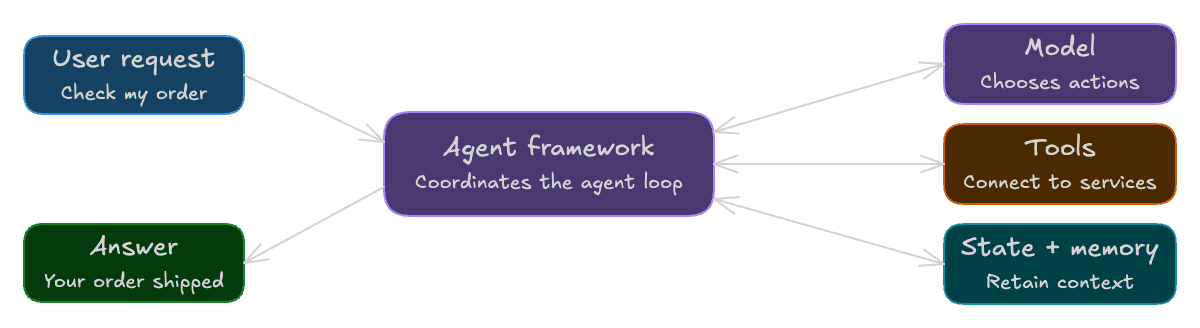
An AI agent is an application that uses a model to decide which steps to take toward a goal. It receives instructions, works with the information available, and can request tools to gather more information or take action. A tool is a function or service exposed to the agent, such as an order lookup, document search, or calendar API.
The framework connects the model to your tools, manages the agent loop, and carries context between steps.
If your application only needs a few model calls and tools, direct API code may be enough. A framework becomes useful when you need to coordinate multiple steps, retain state, handle human approvals, or reuse tracing and evaluation tools across your application.
Agent Loop
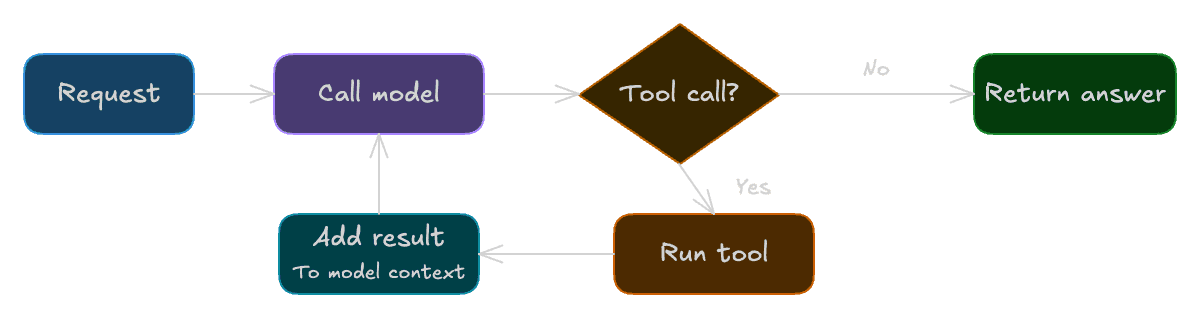
The agent loop is the repeated exchange between a model and the tools it can use. A typical tool-calling loop works like this:
- The app sends the user's request, instructions, and tool descriptions to the model.
- The model returns an answer or requests a tool call with specific arguments.
- The runtime executes the requested tool and adds its result to the conversation.
- The model uses that result to answer or request another action.
- Execution stops when the model finishes, the application requires input, or a configured limit is reached.
Agent vs Workflow
An agent uses a model to choose its next action based on available information. This suits tasks where the next step depends on what it finds, such as investigating support issues, researching a topic, searching company documents, analyzing data, or writing code.
A workflow follows steps and transitions defined in code. It suits repeatable processes such as employee onboarding, routing incoming requests, and invoice approvals. You can combine both approaches, using an agent for open-ended work within a workflow that enforces business rules.
Choosing an AI Agent Framework
The right framework depends on what your application needs to do and how you plan to build and run it. Four factors matter most: application fit, workflow control, developer experience, and cost.
Application Fit
A framework needs to work with your application's language, models, and data sources. The right features depend on the task. For example, a support assistant may need document retrieval and conversation memory, while an extraction agent may rely on validated, structured output.
For TypeScript applications, consider Mastra when you want workflows, memory, retrieval, and development tools together. Vercel AI SDK is a good starting point when model calls and streaming interfaces are your main concern. For Python backends, consider Pydantic AI when typed dependencies and validated results drive the design, or OpenAI Agents SDK when specialist delegation is central to the application.
Workflow Control
Some tasks let the model decide each step, while others follow a fixed sequence or involve several specialist agents. More involved workflows may need branches, retries, or human approval. Saved state becomes important when work pauses or needs to resume after an interruption.
Consider LangGraph when you want to define execution through explicit graph steps and state transitions. CrewAI fits work organized around specialist roles and assigned tasks, with Flows controlling the surrounding process. These capabilities overlap, so choose the approach that makes your application's logic easiest to express and inspect.
Developer Experience
Agents can take different paths through the same task, which makes debugging harder. Traces help explain which tools an agent called and where a run went wrong. Evaluations make it easier to see how changes to prompts, models, or tools affect results across repeatable tasks.
Cost
Even when a framework is free, running agents still costs money for models, tools, and infrastructure. Repeated tool calls, retries, and multiple agents can make a single task more expensive. Managed hosting and observability services can also add to the total.
Popular AI Agent Frameworks
1. Mastra
A good choice for TypeScript teams building agents and workflows in one framework.
Mastra is an open-source TypeScript framework that brings together agent execution, tool integrations, memory, document retrieval, and workflows. It provides much of what an AI application needs in one place, from giving an assistant access to company information to coordinating multi-step processes.
Its workflow tools support branching, parallel tasks, and pauses for human input. This makes it useful for applications that combine open-ended agent work with predictable business processes, such as support or onboarding.
Mastra Studio provides a local development interface for testing agents, inspecting runs, and refining prompts, along with evaluation tools to measure results. It fits teams that want both application features and development tools within their TypeScript stack.
Pros
- Agents, workflows, memory, and retrieval in one framework
- Multiple model providers and configurable storage
- Local development interface, tracing, and evaluations
- Integration with existing applications and self-hosting support
2. LangGraph
A strong choice for complex workflows that need branching, saved progress, and human review.
LangGraph is an open-source Python and TypeScript framework focused on controlling how agents execute tasks. It lets you define which steps run, where the process branches or repeats, and how information moves between them. You can mix fixed application logic with model-driven decisions in the same workflow.
Its main strengths are long-running tasks, saved progress, and human review. With persistent storage configured, an agent can pause, wait for approval, and resume without starting over.
This makes LangGraph useful for research pipelines, approval processes, and other applications that need execution to follow explicit rules. It works independently of LangChain; the separate LangSmith platform provides tracing, evaluation, and deployment tools.
Pros
- Explicit control over branching, loops, and execution order
- Saved progress for interrupted or long-running work
- Human review within agent workflows
- Python and TypeScript support
3. OpenAI Agents SDK
A good option for adding agents, delegation, and tracing to an existing application.
The OpenAI Agents SDK is an open-source Python and TypeScript toolkit for building agents within your own application. It handles repeated exchanges between models and tools, while your code provides the tools, business logic, and deployment environment.
It supports delegating work between agents, so an assistant can involve specialists when a task needs different capabilities. Built-in tracing helps explain what happened during a run, while configurable validation and approval steps provide control over inputs, outputs, and actions.
The SDK suits backend assistants and services that need agent capabilities without a required graph-based workflow. It also supports non-OpenAI models, although available features depend on the provider integration and language SDK.
Pros
- Agent execution without a required graph structure
- Delegation between specialist agents
- Built-in tracing, validation, and approval support
- Python and TypeScript with multiple model integrations
4. CrewAI
A good fit for work that can be divided among a team of specialist agents.
CrewAI is an open-source Python framework built around agents working together. Each agent can have its own role, instructions, and tools, while the framework coordinates their tasks and passes results between them. For example, a research process could divide work among a researcher, an analyst, and a writer.
Tasks can run in a defined order, or a manager agent can coordinate them. Tool integrations and configurable memory help agents access external information and retain context as they work.
CrewAI also provides Flows for conditions, events, and saved state around those teams. Its main appeal is organizing automation around clear responsibilities and deliverables, with controls for how the wider process runs.
Pros
- Teams of agents with distinct roles and tools
- Sequential or manager-coordinated tasks
- Workflow branching and saved state
- Tool integrations and configurable memory
5. Pydantic AI
A strong choice for Python applications that need structured, validated agent results.
Pydantic AI is an open-source Python framework focused on typed dependencies, tool arguments, and outputs. It lets you define the format an agent should return, making results easier to use in application code. This is particularly useful for extracting information, classifying requests, or producing records with specific fields.
Its output validation checks results against that format and can request a correction when validation fails. This helps enforce structure and constraints, though it doesn't establish whether the information is factually correct.
The framework supports multiple model providers, streaming, and connections to application services such as databases. The separate Pydantic Evals package provides evaluation tools, while Logfire or another OpenTelemetry backend can trace runs. It fits Python teams that want agents to work naturally with their existing types and application logic.
Pros
- Typed, validated outputs for application code
- Validation feedback and configurable retries
- Multiple model providers and streaming
- Integration with Python services, tracing, and evaluation tools
6. Vercel AI SDK
A good option for building agents and streaming AI interfaces into web applications.
Vercel AI SDK is an open-source TypeScript toolkit for adding AI features to web applications and Node.js services. It provides common APIs for model calls, structured results, and tools across supported providers, alongside support for agents that use tools over multiple steps.
Its main strength is connecting that backend behavior to the user interface. The UI tools support streaming responses and visible tool activity, so users can see an answer arrive or follow task progress. This suits chat assistants, copilots, and interactive dashboards.
The SDK works with frameworks such as React, Next.js, Vue, and Svelte. Your application supplies the tools and presentation components, while the SDK handles the model interaction and streaming. Vercel hosting is optional.
Pros
- Common APIs across supported model providers
- Agents with repeated tool use
- Streaming responses and visible tool activity
- Multiple frontend frameworks and standalone Node.js support
Comparison Table
Finally, let's summarize the key differences between frameworks in a table.
| Framework | Language | Best For | Main Components | License |
|---|---|---|---|---|
| Mastra | TypeScript | Building agents and applications in TypeScript | Agents, workflows, memory, retrieval, Studio, evaluations | Apache 2.0 core |
| LangGraph | Python, TypeScript | Complex, stateful workflows with explicit orchestration | Graphs, shared state, checkpoints, human intervention | MIT |
| OpenAI Agents SDK | Python, TypeScript | Lightweight agent development with handoffs, guardrails, and tracing | Agent runner, tools, delegation, validation, traces | MIT |
| CrewAI | Python | Role-based agent teams and multi-agent workflows | Agents, tasks, crews, processes, Flows | MIT |
| Pydantic AI | Python | Python agents with type safety and structured outputs | Typed agents, validated outputs, dependencies, tools | MIT |
| Vercel AI SDK | TypeScript/JavaScript | Adding agents and AI interfaces to JavaScript/TypeScript applications | Model APIs, agent loops, structured output, streaming UI | Apache 2.0 |
Conclusion
Mastra brings agent development and workflows together for TypeScript teams. Other frameworks emphasize different needs: explicit orchestration with LangGraph, delegation with the OpenAI Agents SDK, specialist teams with CrewAI, typed outputs with Pydantic AI, and AI interfaces with the Vercel AI SDK.
Try one representative task in your top two choices. Compare the tools called, output quality, development effort, and total running cost before committing.