In our first stealth post, we explained why current "stealth" solutions are fundamentally broken and how we forked Chromium to build the best browser infra.
Bold claim. This post is the proof.
Why stealth needs its own benchmark
The bottleneck for agents is not their intelligence. On most websites users care about, agents get blocked by a CAPTCHA or an antibot challenge. We collected 300,000 security check events from production traffic. The data made it clear: agent intelligence and browser stealth are orthogonal. You need to measure them separately.
Dataset distribution
From those 300,000 security checks, we extracted the 71 most common and well-known websites where agents were getting blocked, and categorized them by antibot vendor:
| Vendor | Sites |
|---|---|
| Cloudflare | 23 |
| PerimeterX | 18 |
| Datadome | 13 |
| Akamai | 8 |
| reCaptcha | 6 |
| Others (incl. Kasada, Shape) | 3 |
| Total | 71 |
If you think a site or vendor is missing, let us know.
Judge criteria
- Simple tasks: 3 steps per site (search, visit a page, read a link). No auth. If it fails, it's because the browser got blocked.
- LLM judge (
gemini-2.5-flash): only evaluates whether the agent was blocked, not whether it completed the task correctly. - Page load failures count as blocks, since some antibots prevent the page from loading entirely.
Control experiments
To confirm the benchmark measures stealth, we tested two baseline browsers on a datacenter IP (GitHub Actions runner):
- Headless Chromium: scored 2%. The most suspicious browser possible, fewer than 2 tasks passed per run.
- Headful Chromium: scored 50%. Same machine, just rendering a visible window. Headless detection is one of the easiest signals for antibots.
This validates that the task set consists of high-security sites and that score improvements reflect real stealth capability.
Results
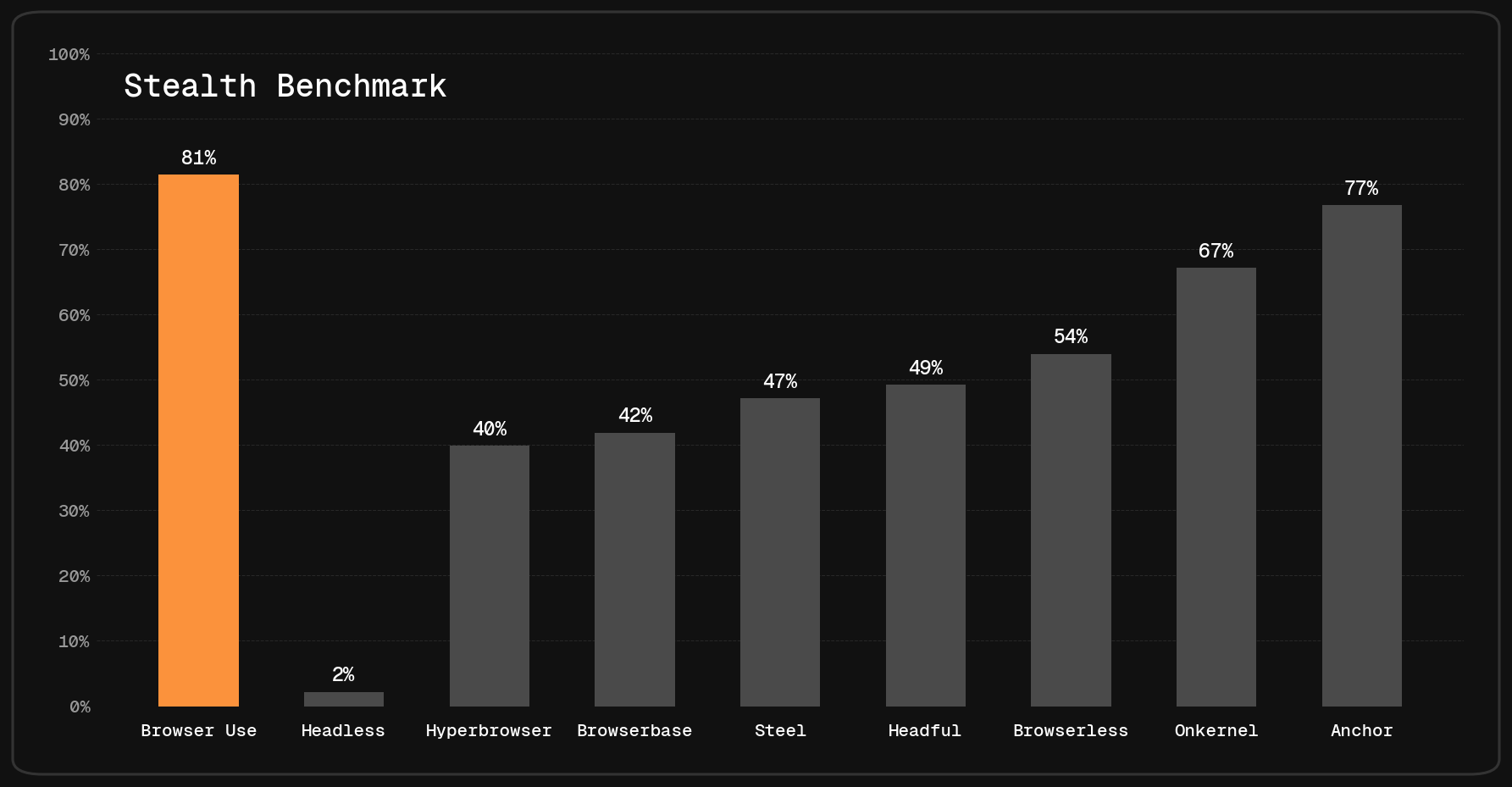
We ran the benchmark across every major cloud browser provider. Each provider was evaluated multiple times with the same agent and model (bu-2-0).
The differences are large and consistent. Browser Use Cloud leads at 81%, followed by Anchor at 77% and Onkernel at 67%. The bottom half (Steel 47%, Browserbase 42%, Hyperbrowser 40%) is far behind.
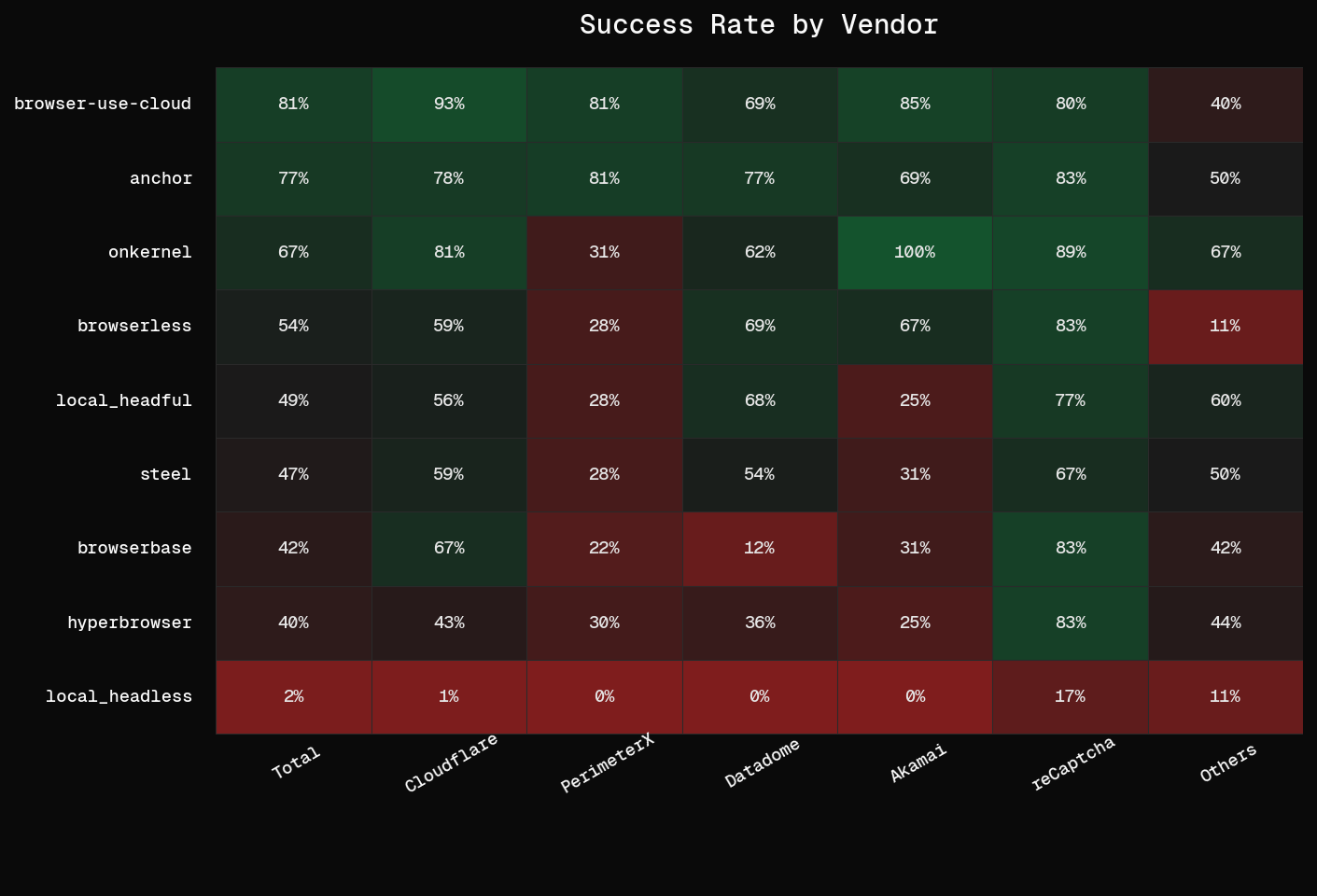
The vendor breakdown reveals where each provider is strong or weak. Browser Use Cloud's highest bypass rates are against Cloudflare (93%), Akamai (85%), and PerimeterX (81%).
BrowserBench
We also ran BrowserBench from Halluminate, a third-party benchmark with 296 tasks across antibot-protected sites. Their task set is not fully focused on high-security websites, so overall scores are higher and differences between providers are smaller.
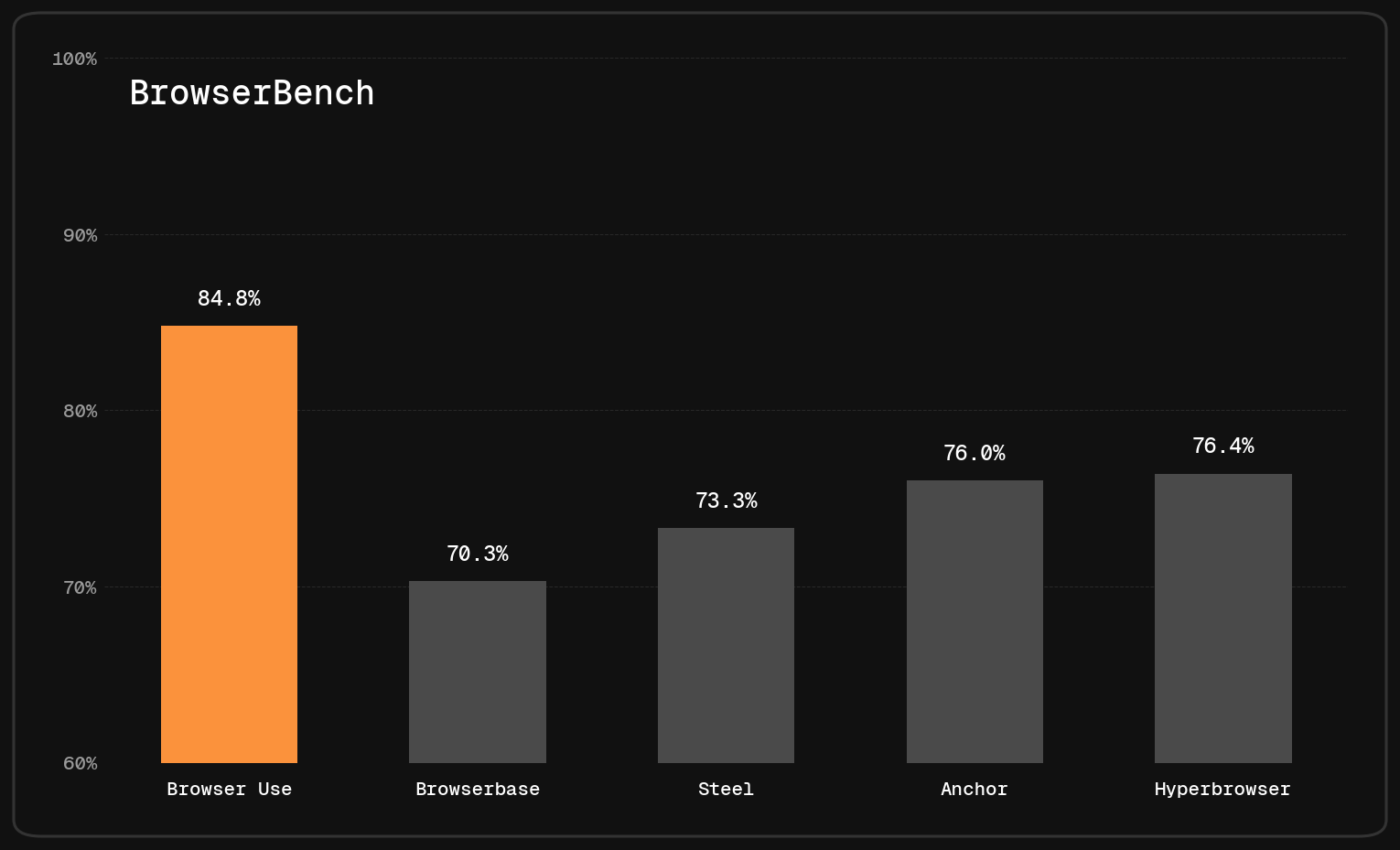
Browser Use Cloud achieved the highest success rate of all providers tested:
- Browser Use Cloud: 84.8%
- Hyperbrowser: 76.4%
- Anchor: 76.0%
- Steel: 73.3%
- Browserbase: 70.3%
Should we trust benchmarks?
Not blindly. Proxy quality varies by the hour, sites update their configs, CAPTCHA difficulty fluctuates. But benchmarks show who is actually putting in the work. When one provider consistently leads across multiple independent benchmarks, that's not noise.
71 sites is a start, not an endpoint. We know vendors and CAPTCHA providers are missing. We'll keep expanding and re-running as the landscape changes.
"Stealth" in the industry
Let's cut the bullshit. Most cloud browser providers slap a residential proxy and a third-party CAPTCHA solver extension on a stock Chromium, put "Advanced Stealth" on the landing page, and call it a day. 🤡
Most major competitors report the same fingerprint: headful Linux Chromium. The movie ends as soon as major antibots stop being lenient and start blocking these obvious leaks. We covered this in detail in our first stealth post.
TL;DR: if your provider's user-agent starts with Mozilla/5.0 (X11; Linux x86_64), run.
What we do instead:
- Fully headless on latest major Chromium version. The only provider that can pull it off
- macOS, Windows & Linux with tens of thousands of real fingerprints
- In-house CAPTCHA solvers and monitoring tools
- Own Chromium fork, maintained and patched non-stop
Stealth is not a feature for us. It's the top priority.
The never-ending cat & mouse game
A solution that works today might break tomorrow. Antibots evolve constantly and no one is immune. We don't pretend to sell a 100% success rate, that doesn't exist. Things break, but nobody works harder than us to keep up.
When your business relies on stealth, the most important thing when choosing a provider is trust in their expertise and work ethic. At Browser Use, we lead, and we prove it.
If you are blocked or tired of your current provider, give us a try or reach out at aitor@browser-use.com. We'll be happy to unblock you and do our best to make it work.
What's next
Next post will be about CAPTCHAs. How we solve them, what we build in-house, and how it works under the hood. We'll also compare features and metrics across providers.
Shoutout to Alexander Yue for building and maintaining the benchmark.
The stealth benchmark is open source at github.com/browser-use/benchmark.